Questions and Answers (and Updates)
Let’s start with the first (and maybe most important) question that brought you here. You are learning about this now because this potential project has reached a point where a traditional public application is set to be considered.
You are also likely learning about this now because you saw the media coverage the potential project received in late September, or the initial round of media attention the potential opportunity received in June of 2025.
And yes, it is a data center.
You may be interested in learning more because of concerns about the environmental impacts of a large project at this location. You might have worries about noise, traffic, or taxes. You might also be here because of excitement about the hundreds of jobs this would create for our area if it moves forward. Or you might be interested in the potential millions in economic development this may bring to our region.
At City Hall, we have certainly heard from people, both concerned and excited, following the second round of reporting in September.
This is the largest proposed project in the history of the City of Hermantown. While it follows similar processes as any Hermantown project, it shouldn’t be a surprise that people have learned about it in advance of that application. It is a proposal worthy of lengthy and thorough due diligence, and it is a project that is worthy of attention before the application and subsequent public process would normally begin. This possibility has involved partners beyond the City of Hermantown, as the county, the sanitary district, and our largest neighbor are all factors in this opportunity. It is a big deal, and people outside of City Hall have been talking about it for several months.
To be even more straightforward, it makes sense that you’d want to know about this.
It is also worth allowing the time for the developer to hone in the specifics of this project before we talk about it publicly as staff, and before they allow their unique approach to what is possible in this development to be available to the greater public. That is a fair, and best-practice, to allow developers that time and space before an application. Future developers, entrepreneurs, and folks with big dreams/ideas know they can count on our city staff to reasonably protect those dreams/ideas until the appropriate time.
Or, to be even more straightforward, it makes sense that we let the homework be completed by any developer before we grade the assignment.
In the first full week of October, that application has been received and can follow the public process.
UPDATE: As noted in the process update on the left, the City of Hermantown received information regarding a petition from the Environmental Quality Board. To appropriately respond to this new request, received on October 21, the consideration of the project application has been paused.
On December 3, 2025, the City responded to the petition received by the Environmental Quality Board in October.
The response can be found here.
UPDATE: The City of Hermantown received a lawsuit regarding this project on November 5. At this time, the city will conduct the appropriate review and due diligence and follow the legal process.
UPDATE: On November 10, the City received an update from Mortenson removing any upcoming applications from the Planning & Zoning Commission and City Council agendas to allow for further public engagement.
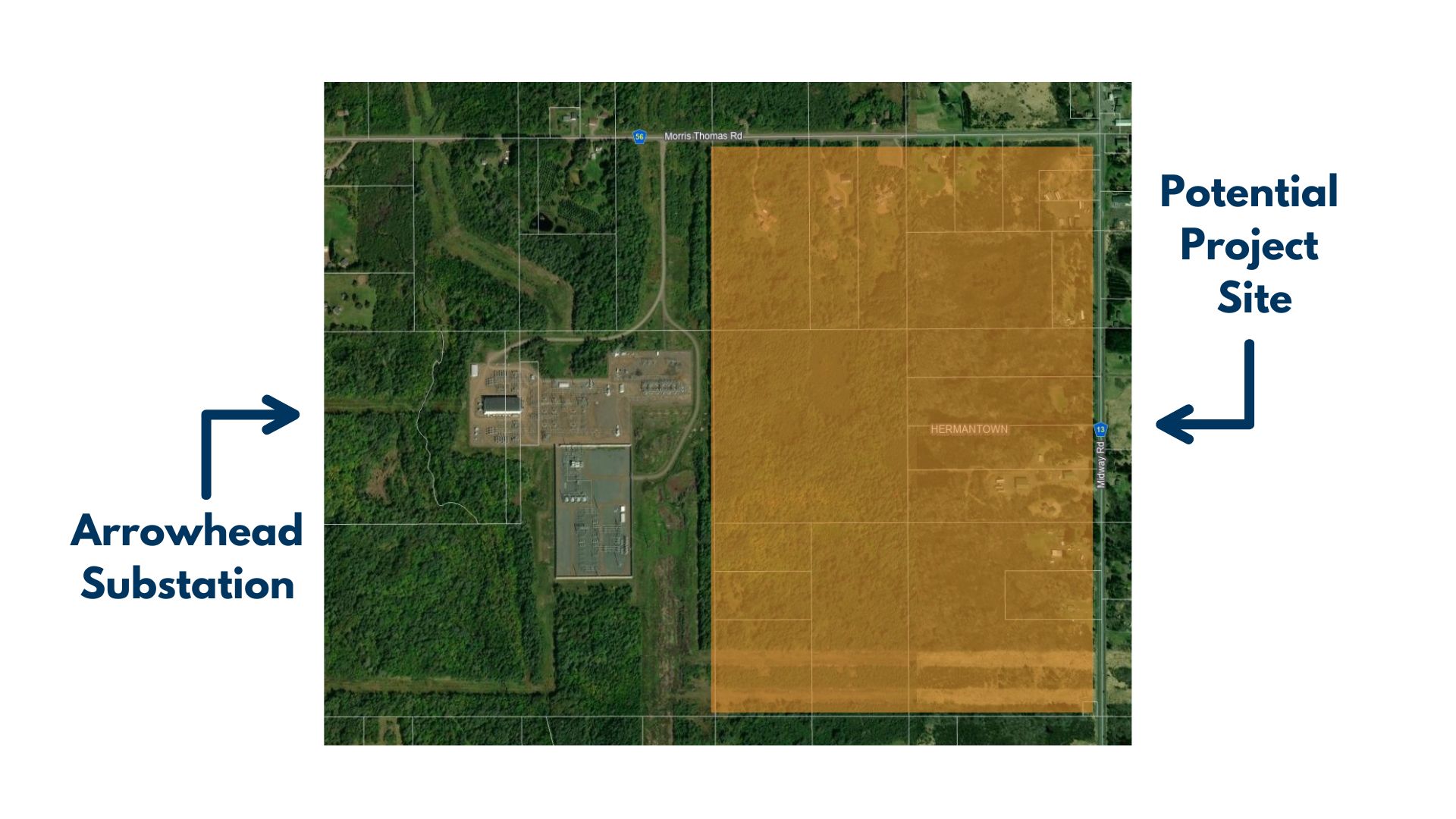
A U.S.-headquartered Fortune 50 company is evaluating the potential for a data center project in the southwest corner of Hermantown, near Midway Rd and Highway 2.
The project has been in a lengthy evaluation phase, which continues now; however, preliminary discussions with city staff outlined the scope of this potential project, which would bring significant investment, job creation, and economic opportunity to Hermantown and St. Louis County.
This proposed communications services project would include up to four data center buildings and supporting infrastructure. All parts of the project, from stormwater mitigation to the buildings themselves would need to meet local and state environmental regulations.
The economic investment of this potential project is hundreds of millions of dollars in steady growth as the project builds out, with the potential of reaching billions over time. This would support not only the City of Hermantown, but St. Louis County, Hermantown Community Schools, and the greater region.
There will be additional community benefits created in partnership with the developer that will also be finalized should this project proceed, so there will be positive impacts in areas such as parks, education, workforce development, and more.
More information on the project specifics can be found in the applications found here, as well in this presentation at the Hermantown City Council Meeting held on October 20.
Let’s start out answering this with a larger lens. Minnesota has long had some of the most robust environmental protections in the country. Additionally, our state also has strong statutory limitations on tax incentives.
This combination means that businesses and industries that choose to invest in Minnesota have to do so with stronger consideration for the natural environment and less financial incentives than neighboring states. Minnesota has more than 80 data centers, including four in the Duluth area, but is only now attracting the larger-scale data center projects that have been seen in other parts of the country.
In the same way, the technology we utilize and rely on daily continues to evolve and improve, and these facilities have as well. And they must in order to meet Minnesota’s environmental expectations.
Beyond the state, this location in Hermantown has a unique draw for this type of investment. This location is directly adjacent to the Arrowhead Substation that was constructed by Minnesota Power in the 1970s. This piece of substantial electrical infrastructure is what has drawn the attention of this type of development. The Arrowhead Substation is a regional energy hub with connections to wind, solar, and hydro power sources. The ability to connect to the necessary energy without having to add lengthy infrastructure makes this an appealing site for users requiring such connectivity.
We have been asked recently what has changed about the Adolph area – the local name used for this southwest corner of Hermantown – when development wasn’t a priority as recently as 2014. The reality is that nothing has changed in that area, which wasn’t already there for many years – the large-scale electrical substation, the heavy-use railroad tracks, and the high-traffic county roads, but what has changed is the way those assets are now valued by the world. That location has not attracted any development until now, where it is being viewed through the lens of this new development opportunity.
There are environmental considerations specific to this site that any developer must address and adhere to. See the question below about wetlands for more on that process.
Job creation is an important part of this project. Construction on this multi-building proposal would occur steadily over an 8-10 year window and employ hundreds of construction workers. As noted by local labor groups at a recent City Council meeting, they have the local workforce and are excited about this possibility, both the project and the timeframe.
There will also be skilled technical roles associated with the long-term operation of this communication services facility. There will be at least 40 full-time positions associated with the initial building, all paying wages higher than the current county average. There may be 100 or more roles at full build out.
Additionally, local suppliers and vendors will also see benefits through the selection of construction, operational contracts, and complementary capabilities that aid in this prospective project. To note; traditionally the data center industry supports more than six jobs for every single job at the data center itself.
There are two important characteristics of this project.
- This project will not use water for cooling purposes.
- This project will utilize municipal water/sewer, not groundwater.
The use of water only for domestic purposes means that the campus will use 50,000 gallons of water per day or less once it is fully built out. To put this into perspective, that is comparable to the amount of daily water usage at one of the newer “tunnel-style” car wash businesses in our area. It is equivalent to the daily use of about 160 homes, which is very nearly to the number Hermantown has added to the water utility over the last five years. (This water usage is an update from the information shared on the handout at the October 6 City Council meeting, which was incorrect. We apologize for this error.)
Because the data center buildings are not using incredible amounts of water for cooling, the water needs of this proposal are similar to those of traditional light industrial complexes. It may not reach the 50,000 gallons per day mark, based on employee needs and fire suppression requirements.
The developer will be funding the extension of city water/sewer infrastructure to the site, which will then be turned over to the City of Hermantown to be publicly owned. This will allow for the continued steady residential growth the community has seen over the last decade and aid in opening areas for much-needed housing opportunities. This is a substantial win for Hermantown, as the costly infrastructure build out and improvements are not paid for by tax increases to Hermantown residents. It will be built at the development’s cost and funded by taxes created by the project.
All of Hermantown’s municipal water and sewer travels through systems managed by the City of Duluth and the Western Lake Superior Sanitary District respectively. These important partners have been deeply involved in scoping this potential project and maintain their roles in protecting the region’s water resources. They have made it clear that this is an amount of water use that can be handled by our current system, while still allowing for the growth Hermantown has seen in the last decade.
The Arrowhead Substation has been located directly west of this proposed site since the 1970s. This important piece of Minnesota Power infrastructure, which continues to receive updates and upgrades over the past five decades of use, will serve the potential data center project.
Beyond laws passed by the state of Minnesota giving current residential and commercial customers even greater protections regarding energy availability and cost, our state is served by a regulated electrical market. This means there is considerable planning for load growth, and laws are in place to protect customers when there are new, larger users connecting.
Minnesota Power has a robust load interconnection study process to ensure grid stability for additional users. Beyond the state requirements, Minnesota Power has a long history of serving legacy large energy-users like our mines and papermills, putting our grid in a strong position to handle new commercial users without negatively impacting the energy or rates of our current users. This energy, and system upgrades, are paid for by the developer, so those improvements and costs are not paid for by existing residential or commercial customers.
Minnesota Power was the first utility in our state to deliver over 50% renewable energy to customers. The company’s Integrated Resource Plan calls for adding renewable projects, customer-focused demand response, energy storage, and reliable baseload generation to replace coal. The diverse combination of resources positions Minnesota Power to meet increasing demand for energy, cease coal use for its customers, and meet Minnesota’s bold carbon-free energy milestones.
You can view Minnesota Power’s informational fact sheet regarding data centers at the following link.
Additionally, recently passed legislation in the state of Minnesota helps provide answers and protections regarding data centers.
Just as advancements have improved the water and energy components of new data centers, the noise factor is also significantly less.
The project operations are modeled to not exceed 50 dBA as measured at the nearest residential homes in accordance with the Minnesota Pollution Control Agency’s noise standard. A similar comparison here would be the sound of a refrigerator or dishwasher.
The reality of this site is that it is already an area with noise. The Arrowhead Substation has been creating a noise factor in this area over the last 50 years. Residents have told us at City Hall that the buzz is sometimes noticeable, but what they hear more of is the regular train traffic and heavy vehicle traffic on Midway Road. More than 20 trains work their way through this area daily, and Midway Road is one of the busiest roads for truck and car traffic in the county.
Additionally, the proposed project’s acoustic study is available for viewing.
This area has specific considerations regarding traffic – as roadways cross railways in multiple locations nearby. This project will generate less operational traffic than other potential industrial uses, like logistics and manufacturing. At full-build out, it will be comparable to a department store with the on-site workers coming and going.
A current traffic study is being assessed to determine if additional traffic signals and support are needed – especially at the intersection of Midway Road and Morris Thomas Road.
Overall, St. Louis County continues its long-range planning for the roads in this area and is working with the City and the developer on the potential for this project and its traffic additions.
Additionally, the proposed project’s traffic analysis is available for viewing
As with any development, large or small, there are environmental considerations. Wetlands are one of those considerations as they are a natural habitat that helps regulate water flow. Along with our state and federal partners, Hermantown has a well-established process for evaluating potential impacts to wetlands, working to minimize those impacts, and offsetting those impacts within the same watershed to limit the negative environmental consequences of any development.
Simply put, any development in Hermantown is going to impact wetlands because Hermantown has a great deal of wetlands.
Through a robust environmental impact evaluation process called an Alternative Urban Areawide Review (AUAR) that is reviewed in partnership with state and federal agencies, this project has created a plan for reducing and managing the environmental impacts. The facility and site design have gone through numerous refinements to accommodate the most critical of the natural infrastructure such as wetlands and trout streams. Stormwater ponds will be designed and built according to city and state regulations to help protect streams – in particular, trout streams – from potential impacts. This project has been designed to minimize local environmental impacts both onsite and downstream.
Looking forward, the project will still have to meet continued marks with the Department of Natural Resources, Minnesota Pollution Control Agency, and additional state agencies during the potential build out.
The same process that has guided recent construction in Hermantown – from our new addition to the hockey arena and Fleet Farm to our trail system and housing developments – will be followed by this project.
More on the proposed project’s stormwater plan can be viewed below.
An Alternative Urban Areawide Review (AUAR) is a hybrid process of the Environmental Assessment Worksheet (EAW) and the Environmental Impact Statement (EIS). Cities can use an AUAR as a planning tool to understand how different development scenarios will impact the environment of their community before development occurs. The process is designed to assess the cumulative impacts of anticipated development scenarios within a specific geographic area. An AUAR must, by law, also be updated every five years.
Hermantown has done two AUAR studies since 2023. In both cases, the AUAR was the appropriate review process to use because the projects themselves were/are still being evaluated and finalized.
An AUAR is a multi-phase, multi-month process that includes review by more than a dozen external expert agencies across the state of Minnesota, as well as several federal agencies. This particular multi-phase AUAR began with an initial study in April of 2025. Due diligence, both on the site and by the agencies, led to a draft being posted in July and finalized in September. Hermantown’s City Council accepted the AUAR at its first meeting in October.
Even with the many external groups who have weighed in on the AUAR, there is still additional environmental marks that any development needs to hit regarding the realities of the site on which they are building. Those important considerations are done with some of those same expert groups, such as the Department of Natural Resources, Minnesota Pollution Control Agency, and the U.S. Corps of Engineers.
The AUAR study itself, including all three phases, can be found here.
Minnesota has a higher tax rate for commercial development than residential. Although the equation can be complex, commercial rates are usually twice as high (or more) than residential rates. Currently this area generates about $80,000 per year in taxes, with the new project likely to generate more than 10 times that in commercial taxes upon full construction.
New types of commercial development help diversify our local and regional tax base beyond the current mix of businesses and residents. This makes our financial situation more resilient to economic changes. The commercial tax base also utilizes core city services differently than residential, as a project like this depends less on parks, schools, fire, and police than residents. In short, a project like this helps significantly to pay for those resources, without using them to the same degree as others.
Page Updated: March 3, 2026
Update: On March 3, 2026, Google announced plans for a data center project in Hermantown. Information regarding that announcement is available below.
City of Hermantown Press Release
Hermantown Chamber of Commerce Press Release
Process Update: On November 10, the City received an update from Mortenson removing any upcoming applications from the Planning & Zoning Commission and City Council agendas to allow for further public engagement.
The City of Hermantown received a lawsuit regarding this project on November 5. At this time, the city will conduct the appropriate review and due diligence and follow the legal process.
The Environmental Quality Board (EQB) received a petition on October 17, 2025, requesting that an Environmental Assessment Worksheet (EAW) be prepared for the data center project proposed in Hermantown.
On December 3, 2025, the City responded to the petition received by the Environmental Quality Board (EQB) in October.
That response can be found here.
It is appropriate for Hermantown to pause the consideration of the previously scheduled Special Use Permit (SUP) and Commercial Industrial Development Permit (CIDP) by the City’s Planning and Zoning Commission at its October 21 meeting.
Traditionally, the inclusion of a permit in the Planning and Zoning commission agenda is the point at which people first learn about a project – but this unique project has followed a different public path.
The current pause to perform this important environmental step allows time for the public to review the proposal, as well as for the potential scheduling of more informational meetings. Please review the information below from the application and past meetings, and check back for updates as more information becomes available.
- View Fox 21 Discussion regarding the EQB pause, process, and project
- View WDIO full interview regarding the possible data center project
- SUP & CIDP Applications/Information
- The above is the original Planning & Zoning Agenda before the items were removed
- Mortenson and Minnesota Power Presentation – October 20 City Council Meeting
- EQB Information
- Mortenson Letter to the City of Hermantown – November 10
Additional study elements from the proposed project are available below.
- Acoustic Study
- Stormwater Management Report
- Traffic Analysis
- Architectural Narrative
- Site Development Plan
- Landscape Rendering
- Landscape Sections
Read Western Lake Superior Sanitary District’s recent blog regarding data centers and wastewater.
View Minnesota Power’s information regarding data centers.